


Would You Rather Choose?
4.1442.00 Reviews
App Specs
- Version
- 11.0.1
- Updated On
- License
- Free
- Downloads
- 500,000+
- Developer
- KDR Games
- Categories
- Trivia
- Platform
- Android
Screenshots
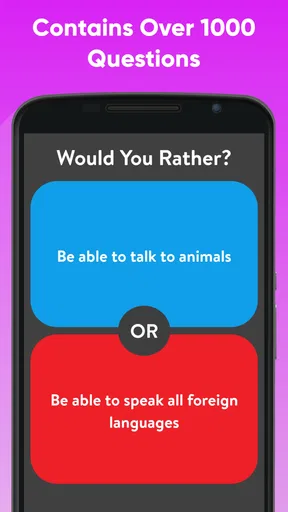
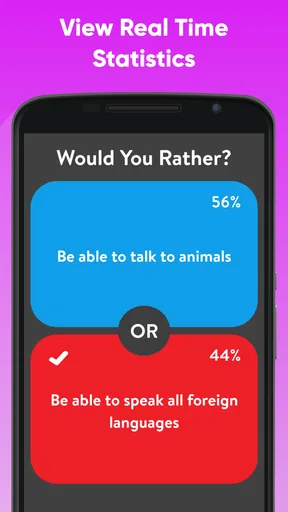
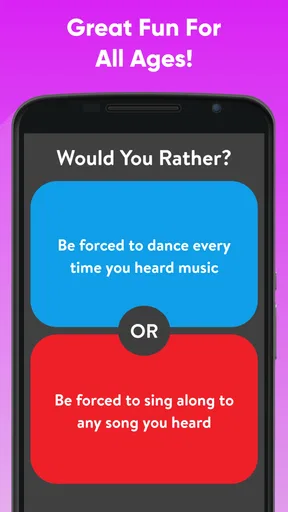
 Analysis by AppCompare
When a group runs out of conversation, a simple question can work better than another round of small talk. That is the appeal of Would You Rather Choose?: it turns quick choices into a reason to laugh, disagree, and learn a little about the people around you. I like the idea most as a low-effort party prompt rather than a game that needs a winner or a long explanation. It is a free trivia game from KDR Games, and its straightforward format makes it easy to bring into a casual gathering.
Why the two-choice format works in a group
A good “would you rather” question does more than ask someone to pick an option. The choice gives everyone else a natural follow-up: why that one, what would make you change your mind, and who in the group would choose the opposite? That makes this kind of trivia useful when people are still getting comfortable with one another. You do not need to know the rules of a board game or prepare a topic in advance; the question itself gives the conversation a starting point.
In practice, I would use it in short bursts. At a dinner with friends, for example, one person can read a prompt aloud, everyone can choose, and the group can spend a minute comparing reasons before moving on. If a question sparks a lively debate, there is no need to rush to the next one. If it falls flat, the group can simply continue. That flexibility is a strength: the app can fill a brief pause without demanding that the whole evening revolve around it.
What to expect from the available questions
The published description calls it a group party game, and that is the most useful way to think about it. The experience centers on choosing between two possibilities, not on mastering a complex trivia system or keeping score. Its listed categories include Funny, Deep, Random, and Controversial, which suggest different moods for different groups. I would start with lighter prompts among new acquaintances and save more divisive or personal choices for people who already feel at ease with one another.
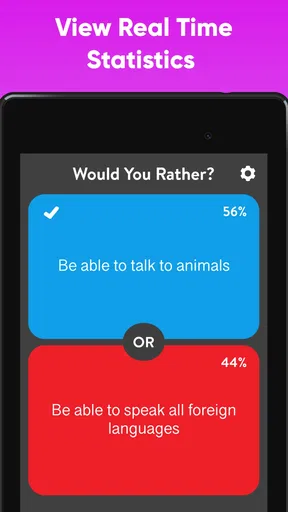
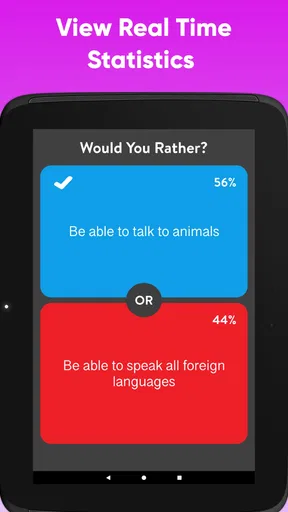
The option to see how other players voted can add a second layer to a question. Instead of stopping at each person’s answer, the group can compare its own split with the broader voting result and ask why the choices differ. That feature is most interesting when treated as a conversation starter, not as proof that one answer is right. A majority vote does not explain anyone’s reasoning, and a surprising result is more fun when people talk through it rather than simply moving on.
Being able to submit questions also gives players a way to bring their own humor and interests into the session. I would use that thoughtfully: a prompt that makes sense among close friends may feel awkward with coworkers or relatives. Before sharing a question, consider who is in the room and whether both choices leave people comfortable answering. That small bit of judgment matters more here than any elaborate setup, especially when the app is being used with a mixed-age or unfamiliar group.
Simple to pick up, with a few practical trade-offs
The game is built around a familiar premise, so it should be approachable for someone who has never used this particular app. That is useful when one person is holding the phone while everyone else joins in verbally. You can keep the device in one person’s hands and read prompts to the group, which avoids asking every participant to install or learn the game before playing. It also makes the format easier to fit into a short wait or a relaxed evening.
Worth Reading Before You Choose

EA SPORTS FC Mobile 26 Is a Bigger Football Game, but It Takes Time

Flipboard Shows What News Apps Must Do Beyond the Feed

Switching to Android Auto Means Rethinking Your Driving Routine

Google Calendar Makes a Crowded Week Easier to Manage

Ludo King Makes the Most of the Minutes Between Plans

Baby Panda World Brings Quick Play to Modern Phones, but Its Game Library Feels Busy
There are limits to that simplicity. A stream of questions cannot guarantee that every prompt suits every audience, and the group still has to do the social work of deciding what is funny, interesting, or too personal. A question app also depends on the people playing: if everyone gives a one-word answer and no one wants to explain their choice, the conversation may stop quickly. I would not choose it for a group looking for tactical competition, a clear winner, or a structured challenge with goals to complete.
It is also worth keeping the social setting in mind when using the more provocative category. “Controversial” can be entertaining among friends who enjoy disagreement, but it may be a poor fit for a family gathering with different comfort levels or a first meeting where people are being cautious. My practical approach would be to switch categories when the room’s mood changes instead of treating every prompt as something the group must answer. Skipping a question is a perfectly sensible way to keep a casual game casual.
Who will get the most out of it
I can see this working best for friends sharing a meal, a family passing time together, or a small group looking for an easy activity while waiting around. It can also help a host avoid planning a full party game: one person opens the app, reads a question, and lets the answers take the discussion wherever it naturally goes. The game’s appeal is less about prolonged play than about having a ready-made prompt when the conversation needs a nudge.
For a realistic use, imagine friends waiting for food at a restaurant, with the conversation slowing while everyone checks their phones. One person can suggest a quick round, read a funny question, and ask everyone to explain their choice. If the group enjoys it, they can try a different category; if not, they can put the phone away after a few prompts. That low commitment is precisely why I would keep it available for informal moments rather than plan an entire event around it.
By contrast, someone who prefers solo puzzles, carefully researched quiz questions, or a game with measurable progress may find the format too light. It is not a substitute for a trivia contest where players test what they know, since the central appeal is personal preference and discussion rather than factual recall. Likewise, anyone who dislikes sharing opinions in a group may be happier with a game that can be played privately. The best fit is a player who enjoys hearing how other people think, not just tapping through choices.
How it compares with familiar party games
Compared with a deck of conversation cards, the app is convenient because the prompts are on a phone rather than something the host has to bring along. A physical deck may feel more natural for a screen-free gathering, and it can be easier to pass around without making one person the unofficial host. This game suits people who already have a phone nearby and want to start with minimal preparation. Neither approach is automatically better; the room’s preference for screens or physical activities is the deciding factor.
Compared with word games or competitive trivia, this format asks less of players and leaves more room for personal stories. That makes it welcoming to people who do not want to compete, but it also means there is less structure to carry the session when discussion fades. I would pick a quiz game for a group eager to score points and show off knowledge, and choose this one when the goal is relaxed conversation. It is a useful distinction: the app is a prompt generator for social play, not a replacement for every kind of party game.
Age, cost, and choosing when to play
The game carries a Teen content rating, so I would take that into account when deciding whether it suits younger players or a family group. The category and tone of a prompt can matter as much as the game’s basic format, particularly when children, teens, and adults are playing together. For a mixed group, I would preview the mood by starting with lighter questions and be ready to skip anything that does not fit. That makes the experience easier to tailor without assuming that every category works for every gathering.
It is free to download, with in-app purchases listed from $1.49 to $2.99 per item. The free entry point makes it easy to try for an occasional get-together, while the purchase range is worth knowing if you prefer to avoid optional spending. I would check the purchase choices in the app before handing a device to a child or letting a group browse unsupervised. That is a practical precaution, not a reason to rule out the game.
The game has a 4.2 average from around 4.7 thousand ratings, and it has passed 500 thousand installs. It first appeared on June 16, 2019; version 10.1.0 requires Android 6.0 or later. Those details make it easier to judge whether it is likely to run on an older Android device, though the social format itself remains the main reason to try it. If you are choosing for an iPhone or another platform, check the relevant store page for compatibility before downloading.
My verdict on its place in a party
What I appreciate is that the game does not ask a group to commit to a long session. You can use one question to break a lull, keep going while everyone is engaged, or stop without leaving a round unfinished. That makes it more adaptable than a formal party game, but less satisfying for people who want a clear arc or a defined end point. Its value depends on whether the people around you enjoy explaining their choices.
Would You Rather Choose? is a sensible pick for casual groups that want conversation prompts close at hand, especially when nobody has brought a game or planned an activity. I would recommend it to friends and families who like playful disagreement and do not mind a phone being part of the gathering. I would skip it for a screen-free event, a competitive trivia night, or a group that would rather not discuss personal preferences. Used in the right setting, it is an easy way to get people talking; it is not a guarantee that every question will land, and it does not need to be.
What’s the Buzz About?
Would You Rather Choose? is a fun and interactive app that presents you with a series of "would you rather" questions. If you’ve ever played this classic game, you’ll know just how entertaining it can be. Now, imagine having an endless supply of questions right at your fingertips. That’s exactly what this app offers!
Getting Started
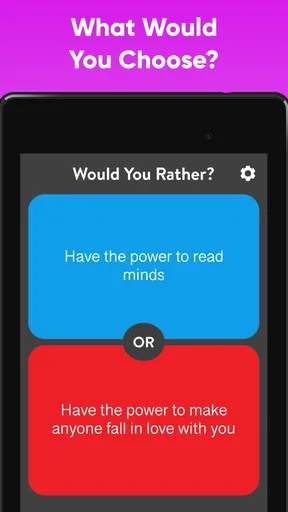
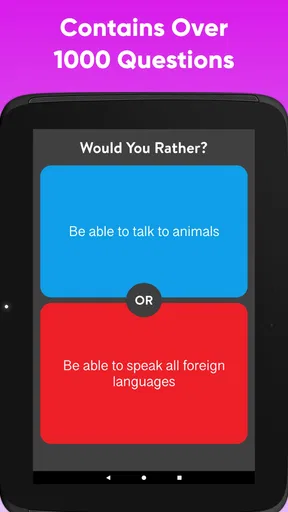
The moment you open the app, you’re greeted with a sleek and user-friendly interface. It’s intuitive, which means you won’t spend ages figuring out how to navigate it. You just dive straight into the fun. The app throws questions at you, and you simply choose between the two options presented. Easy peasy!
A Deep Dive Into the Features
Let’s talk features. This app knows how to keep things fresh. You’ve got categories ranging from "Funny" to "Deep" and everything in between. Feeling adventurous? Try the "Random" category and see where it takes you. And if you’re someone who loves a good debate, the "Controversial" questions will definitely stir up some interesting discussions.
Another cool feature is the ability to see how others voted. This adds a layer of intrigue and makes you wonder just how predictable (or unpredictable) people can be. Plus, you can submit your own questions, which means the app is constantly evolving with user-generated content.
Why It’s a Must-Have
So, why should you download it? For starters, it’s a fantastic way to bond with friends and family. Whether you’re at a party or just hanging out, it’s guaranteed to keep everyone entertained. It’s also great for those awkward silences or when you just need a quick laugh.
I’ve found myself opening the app during commutes and even while waiting in line. It’s a brilliant way to pass the time and keep your mind engaged. Plus, it’s completely free, which is a huge bonus.
The Final Word
In a world full of apps vying for your attention, this trivia game stands out as a unique and entertaining option. It’s simple yet addictive, and it offers endless possibilities for fun and conversation. So why not give it a try? Download it today, and you’ll never have a dull moment again!
Pros
- Engaging questions spark lively debates.
- Simple interface for easy navigation.
- Frequent updates with new questions.
- Encourages critical thinking and decision-making.
- Great for social gatherings and parties.
Cons
- Limited question categories can get repetitive.
- Requires internet for accessing new questions.
- Ads can interrupt gameplay frequently.
- No option for user-submitted questions.
- Lacks multiplayer mode for remote play.
FAQs for Would You Rather Choose?
What is 'Would You Rather Choose?' and how does it work?
'Would You Rather Choose?' is an engaging decision-making game that presents players with two challenging scenarios. Players must choose between the two options, each with its own unique twists. The game is designed to spark conversation and debate, making it ideal for parties or casual gatherings. It features a wide range of categories, ensuring there's something for everyone.
Is 'Would You Rather Choose?' suitable for all ages?
The game is generally suitable for a wide audience, but it’s important to note that some questions might not be appropriate for younger players. The app usually provides different modes or filters to ensure age-appropriate content. Parents are encouraged to review the settings and content to ensure it aligns with their family’s standards.
Does 'Would You Rather Choose?' require an internet connection to play?
'Would You Rather Choose?' can typically be played offline, making it a great option for on-the-go entertainment. However, some features, such as content updates or sharing your choices on social media, may require an internet connection. Always check the app’s requirements in the store description for specific details.
Are there in-app purchases or ads in 'Would You Rather Choose?'
Yes, 'Would You Rather Choose?' often includes in-app purchases and ads. These purchases may offer additional question packs or remove ads for a more streamlined experience. While ads are generally not overly intrusive, purchasing the ad-free version might enhance gameplay for those seeking uninterrupted play.
How can I share my choices in 'Would You Rather Choose?' with friends?
The app typically offers built-in social sharing options that allow players to post their choices directly to platforms like Facebook, Instagram, or Twitter. This feature encourages interaction by letting players compare decisions and spark discussions with friends online. Ensure that social media permissions are enabled within the app settings.


